Know Your Gold. Understand Your Diamonds.
Explore gold purity, diamond quality, and the details to consider when choosing your next Kaastham piece.
The beauty of gold and diamonds is immediately visible. Their specifications take a little more explanation.
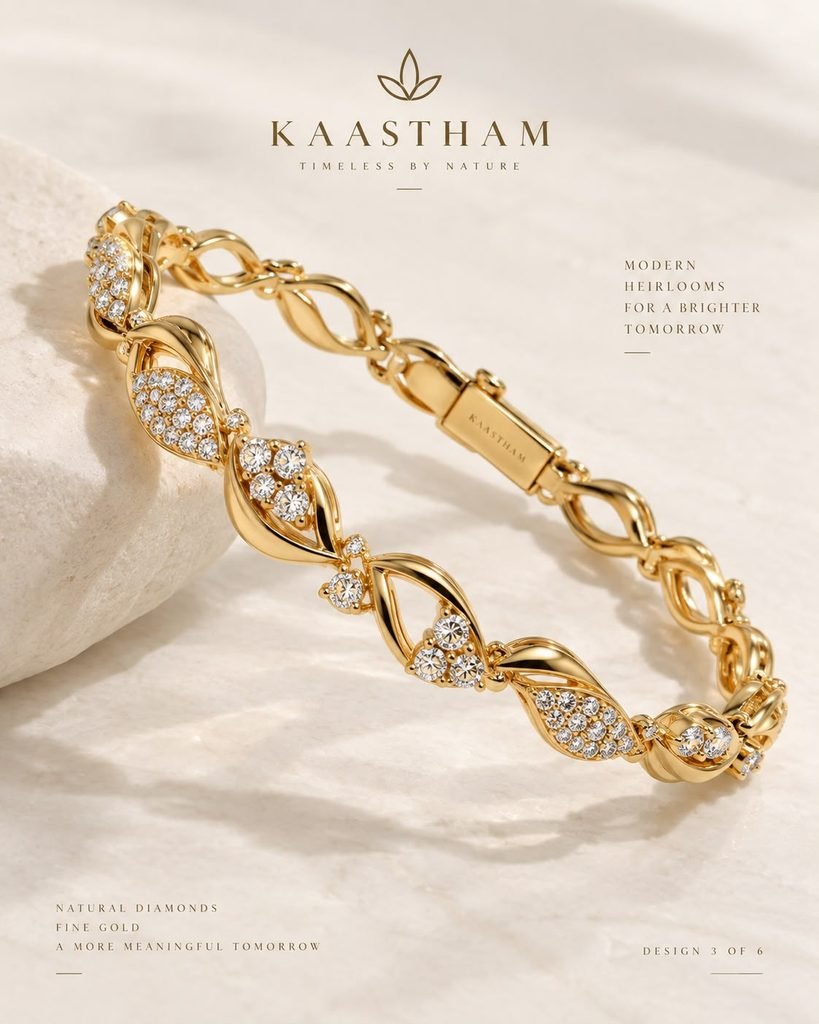
Terms such as purity, karat, carat weight, clarity, and hallmark describe different characteristics. Understanding them helps you ask better questions and recognise what contributes to the jewellery you are considering.
As a gold and diamond jewellery brand, Kaastham belongs to a category where material information matters alongside design. This guide explains the key terms in straightforward language.
Gold purity: what the numbers mean
Gold purity describes the proportion of gold in a metal alloy.
The karat system divides that proportion into twenty-four parts. In 18K gold, eighteen of those parts are gold, corresponding to 75% gold content. The remaining portion consists of other metals.
| Purity | Approximate gold content |
|---|---|
| 24K | Pure or near-pure gold, according to its stated fineness |
| 22K | 91.7% |
| 18K | 75% |
| 14K | 58.3% |
Other metals in an alloy influence characteristics such as colour and hardness. A higher purity number indicates more gold, but it does not establish that every design made in that purity will be more suitable for every purpose. FTC guide to precious-metal jewellery
When choosing a piece, ask why the stated material suits its construction and intended wear.
Purity and construction answer different questions
Two pieces can share the same gold purity while differing considerably in construction.
One may use fine, delicate elements; another may have a broader profile. A piece may also be hollow or solid in structure.
These differences affect the experience of wearing and caring for the jewellery. Ask about the structure if weight, frequent wear, or future repairs are important to your decision.
For any Kaastham purchase, consider the individual piece’s specifications rather than making assumptions from its appearance.
Karat and carat are different
These similar-sounding terms can be confusing.
Karat, often abbreviated as K, describes gold purity.
Carat, often abbreviated as ct, describes gemstone weight.
A description of “18K gold with diamonds” therefore contains two separate material questions: the gold’s purity and the diamonds’ characteristics.
For jewellery set with multiple diamonds, check whether a listed weight is the total diamond weight. A piece containing several diamonds with a combined weight of one carat is different from a piece containing a single one-carat diamond.
Understanding the diamond 4Cs
The 4Cs provide a familiar framework for discussing diamond quality: colour, clarity, cut, and carat weight.
Colour describes a diamond’s colour characteristics under the relevant grading approach.
Clarity concerns internal characteristics and external features.
Cut concerns how a diamond has been fashioned and, where assessed, aspects of its proportions and light performance. Shape names such as round, oval, and pear do not by themselves describe cut quality.
Carat weight describes weight. It does not directly tell you how large a diamond will look when viewed from above.
These characteristics work together. Two diamonds of the same weight can differ in appearance and value. GIA diamond quality factors
When viewing jewellery, pay attention to the overall appearance as well as the written specifications. Look at the piece at a normal viewing distance and, where possible, under more than one lighting condition.
Natural and laboratory-grown diamonds
Natural and laboratory-grown diamonds have essentially the same chemical, physical, and optical properties, but their origins differ. Natural diamonds form within the Earth, while laboratory-grown diamonds are produced through technological processes.
Diamond simulants, including cubic zirconia and moissanite, are different materials. A product description should clearly identify which material is present. GIA guide to diamond origins
Ask for an explicit description of the diamonds in the jewellery you are considering. Do not infer origin from appearance or from a general term such as “diamond jewellery.”
Hallmarks and gemstone reports
A precious-metal hallmark and a gemstone laboratory report serve different purposes.
In India, the BIS HUID hallmark for gold includes the BIS logo, purity expressed in caratage and fineness, and a six-character alphanumeric identification number. Consumers can use the BIS Care app to verify the HUID. BIS hallmarking FAQs
A gemstone report describes findings within the scope of the laboratory’s examination. Check which stone or item the report covers and what information it provides.
Quality includes the finished piece
Documentation is valuable, but the jewellery itself also deserves attention.
Examine the clasp, connecting links, setting, underside, and surfaces that touch the skin. Check whether the design feels balanced and whether its details appear consistently finished.
For Kaastham customers, understanding materials can make appreciation more complete. You can enjoy the beauty of a piece while knowing which questions explain its composition, construction, and care.